Why QuickBooks Error 3120 Appears During Invoice Processing
When businesses rely on QuickBooks for daily accounting operations, invoice creation is one of the most frequently used functions. It connects customers, sales, taxes, and financial reporting into a single workflow.However, many users report that QuickBooks Error 3120 appears specifically during invoice processing, which can interrupt billing cycles, delay payments, or prevent invoices from being saved or synced properly.To understand this clearly, it’s important to look at how invoice processing actually works inside QuickBooks—and where the system can break down.
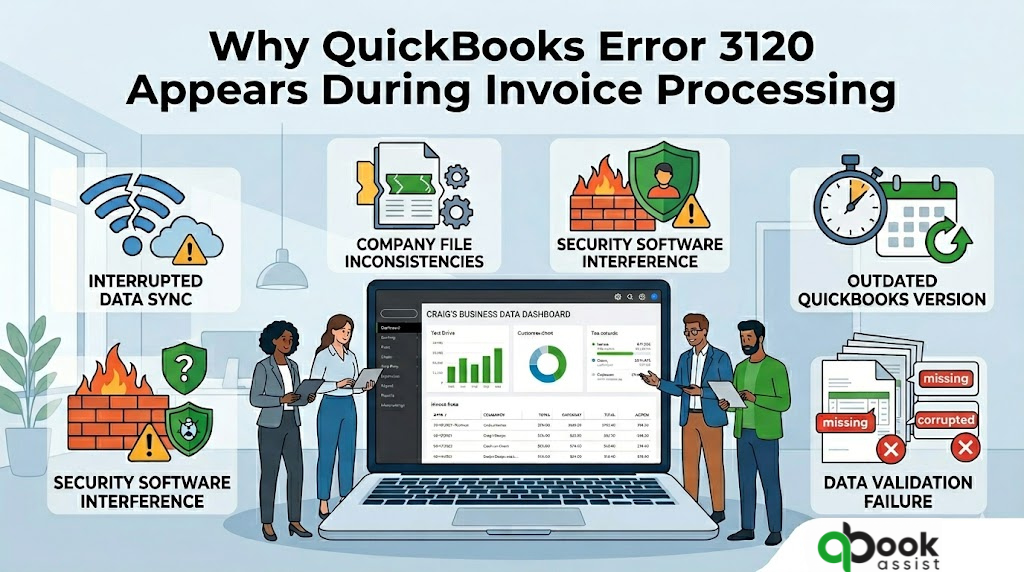
How Invoice Processing Works Behind the Scenes
When you create an invoice in QuickBooks, the software doesn’t just “save a document.” Instead, it performs multiple background actions at the same time, such as:
- Validating customer information
- Checking product/service tax rules
- Updating account balances
- Syncing transaction records
- Communicating with internal company file data
If even one of these steps fails or gets interrupted, QuickBooks may stop the process and trigger an error like Error 3120.This is why the issue often feels sudden—everything looks normal until the final moment when the system tries to complete the transaction.
1. Data Sync Breakdown During Invoice Creation (Most Common Cause)
One of the biggest reasons this error appears is a failure in data synchronization while processing invoices. In many modern QuickBooks setups, invoice data is continuously synced between:
- customer records
- item/service lists
- tax settings
- payment and accounting modules
If this sync is interrupted—even for a few seconds—the invoice process may not complete properly. Users often experience this when:
- switching between online and desktop modes
- working with large datasets
- or processing multiple invoices at once
In such cases, QuickBooks cannot complete the internal validation cycle, leading to Error 3120.
2. Inconsistent or Corrupted Invoice-Related Data
Another major trigger is data inconsistency inside the company file. This can happen gradually over time and may not be visible to the user. For example:
- a customer record may be partially updated
- an item may have missing tax configuration
- previous invoice entries may contain mismatched values
When QuickBooks tries to pull this information during invoice generation, it runs a validation check. If the data doesn’t match expected structure, the process is interrupted. This type of issue is more common in businesses with:
- high invoice volume
- frequent edits to past transactions
- multiple users accessing the same company file
3. Network Instability During Real-Time Invoice Processing
Although invoicing may feel like a local task, many QuickBooks operations depend on real-time communication. If the system is connected to online services (bank feeds, payment gateways, or cloud sync), a stable internet connection becomes essential. Even a brief disruption can cause:
- incomplete transaction submission
- failed data acknowledgment from servers
- delayed synchronization responses
In practice, users often notice this during peak internet usage hours, VPN connections, or unstable Wi-Fi environments. When QuickBooks detects incomplete communication, it may stop invoice processing and show Error 3120 as a protective response.
4. Firewall and Antivirus Interference (Hidden but Common Issue)
Security software is another silent contributor to this error. Firewalls and antivirus programs are designed to protect your system, but they sometimes restrict QuickBooks processes that are required for invoice handling. During invoice creation, QuickBooks may need to:
- verify license and service access
- sync transaction data in real time
- communicate with background services
If any of these actions are blocked, the invoice process may freeze or fail. Many users only discover this issue after checking system logs or temporarily disabling security software for testing.
5. Outdated QuickBooks Version Affecting Invoice Modules
Software updates are not just about new features—they often include fixes for internal processing logic. If QuickBooks is outdated, invoice-related modules may not function correctly with:
- updated tax structures
- new payment rules
- improved syncing protocols
This mismatch can lead to unexpected errors during invoice creation. In real-world scenarios, users often notice that updating QuickBooks resolves the issue without any additional troubleshooting.
6. System Configuration and User Permission Issues
Sometimes the problem is not within QuickBooks itself but in the operating environment. Common system-related triggers include:
- incorrect system date/time settings
- insufficient user permissions
- incomplete Windows updates
- restricted folder access for company files
These factors may prevent QuickBooks from properly saving or validating invoice data. Even if everything appears normal on the surface, these background restrictions can silently disrupt invoice processing.
7. High Load or Multi-Tasking During Accounting Operations
In busy business environments, invoice processing rarely happens in isolation. When multiple tasks are running simultaneously—such as:
- payroll updates
- bank reconciliation
- bulk invoice generation
- report generation
QuickBooks may experience temporary processing delays. If the system cannot handle all validation tasks in time, it may interrupt invoice creation and trigger Error 3120.This is especially common during:
- month-end closing
- tax filing periods
- high sales cycles
In Real-World Terms
Most users don’t notice these technical layers. From their perspective, everything is fine until an invoice suddenly fails to save or process.In reality, QuickBooks Error 3120 during invoice processing usually means one thing:
The system could not complete all required validation and sync steps for that invoice at that moment.It is typically not a permanent failure, but a temporary breakdown in data flow or system communication.
